Little Olympus—the legendary mountain of monks and skiers above Bursa
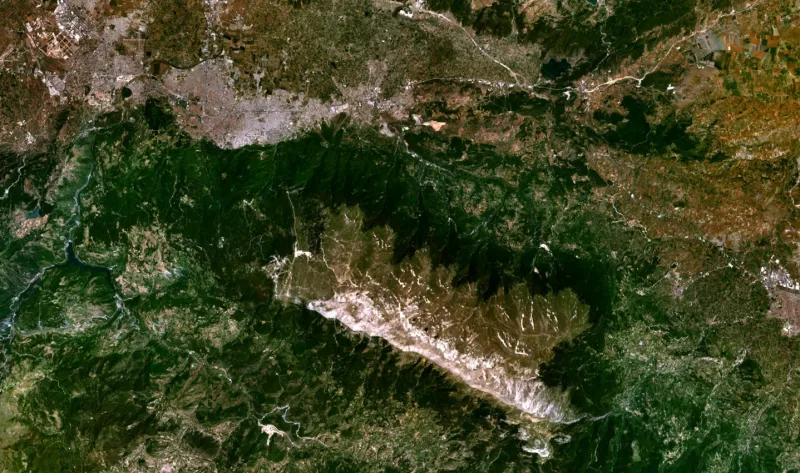
When you look south from Bursa, the horizon isn’t flat—it rises sharply and ends at a snow-capped peak 2,543 meters high. This is Little Olympus, known in Turkish as Uludağ, “the Great Mountain.” The Greeks called it Olympus of Bithynia or Mysia, and it was here that Orthodox monks seeking solitude had been retreating since the time of Diocletian. Later, the laughter of skiers echoed here, but the centuries-old monastery ruins remain hidden among the folds of the coniferous forests. Little Olympus is the highest peak in all of Western Anatolia and the Aegean region, the largest ski resort in Western Turkey, and a place where history meets wild nature. It’s easy to reach from Bursa and even from Istanbul in a single day.
History and Origin of Little Olympus
The Greeks coined the name of this mountain in ancient times. They called the ridge stretching along the southern edge of Bithynia “Olympos”—just like the main sacred mountain near Thessaloniki. The eastern section of the range was called Bithynian Olympus, and the western section, Mysian Olympus. Near the mountain, the city of Prusa—the future Bursa—was founded, which bore the official suffix “Prusa ad Olympum,” meaning “Prusa near Olympus.” Herodotus mentioned that a fearsome boar roamed the Mysian Olympus, which the son of the Lydian king Croesus hunted—and perished during that hunt.
The Middle Ages transformed the mountain into a monastic center. As early as the time of Diocletian, the first hermits began settling in its caves. In the 8th–9th centuries, during the era of iconoclastic disputes, Little Olympus became a refuge for monks who opposed the policies of the iconoclastic emperors. Russian Wikipedia notes that it was precisely this connection between the monks and the mountain that gave it special authority until the 11th century. One of the greatest monks of the Christian East—John the Great, a Byzantine miracle-worker—lived here, ending his life as a hermit on this slope.
Among the mountain’s monasteries, the “Polychronion Monastery” (Polychronion) stands out; its abbot in the 9th century was Methodius of Thessaloniki—the future first teacher of the Slavs and creator of the Glagolitic alphabet alongside his brother Cyril. Another ascetic—Platon the Studite (8th century), associated with the monasteries of Symvolech and Sakudion—drew his nephew Theodore the Studite to monastic life on the mountain; Theodore later became one of the most influential theologians of Constantinople. In the first half of the 10th century, the abbot of one of the local monasteries was Euthymius, an Alanic missionary.
In 1317, the Turks captured the mountain, and for several centuries it served as a hunting ground—first for the Seljuk sultans, then for the Ottoman sultans. The name “Keshish-dag,” or “Monk’s Mountain,” which they gave it, remained in common use for a long time. In 1933, the first hotel was built here and a highway was constructed. In 1961, Uludağ was declared a national park.
Architecture and What to See
Little Olympus is first and foremost a landscape, not an architectural ensemble. There are no mosques with minarets or ancient amphitheaters here—there is a mountain with its vertical zones, each offering its own experience.
Kartaltepe Peak and Snow
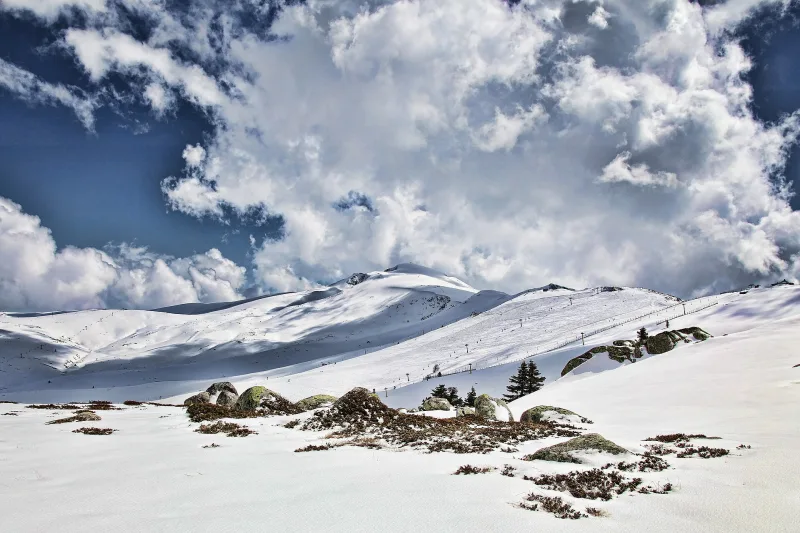
The highest point is Kartaltepe, 2,543 meters above sea level. It is the highest point in the Marmara region and the entire western part of the Anatolian Peninsula. In winter, the summit and surrounding slopes are covered in snow, which lasts from December through April, and sometimes even longer. This is where the main ski area is located: hotels, lifts, and slopes. The Uludağ ski resort hosted the European stages of the CEV Snow Volleyball Tour in 2017 and 2018—a fact that speaks to its international recognition.
Northern Plateaus and Alpine Meadows
To the north of the summit lies a chain of high-altitude plateaus: Sarıalan (about 1,630 meters), Kirazlıyayla, Kadıyayla (about 1,200 meters), and Sobra. In spring and early summer, alpine meadows bloom here—yellow Crocus flavus and purple Crocus siberi, pink Primula vulgaris var. sibthorpii, leopard’s-bane (Doronicum orientale), and grape hyacinths. This is a magnet for botanists and photographers, though there are far fewer of them during the tourist season than there are skiers in winter.
Forest Belt and Birds
Oak savannas rise up the mountain slopes, followed by deciduous forest, then a beech-fir forest, and, higher up, alpine meadows. The dense fir forests are home to Tengmalm’s owl—a species extremely rare in Turkey—as well as the white-backed woodpecker and the common nutcracker. Bearded vultures and other vultures, golden eagles, and more than twenty other species of birds of prey circle the cliffs. Among the eastern specialties are the Spanish rock partridge and the Alpine accentor. Several packs of wolves inhabit the mountain.
Abandoned tungsten mine
Near the summit, the ruins of a tungsten mine and processing plant remain; built in 1974 at a cost of $60 million, they were closed in 1989 due to high production costs. For fans of industrial archaeology, this is a rare find: large concrete structures at an altitude of over 2,000 meters look surreal amid the mountain landscape.
A Rare Butterfly
Little Olympus is one of the habitats of the rare butterfly Parnassius apollo graslini, which entomologists specifically travel to see in June–July. This is a subspecies of the Alpine Apollo, listed on many conservation lists in Europe and Asia.
Interesting facts and legends
- Herodotus describes the hunt for the wild boar of Mount Olympus in Mysia, which claimed the life of Croesus’s son—one of the few instances where this specific mountain is mentioned in Greek historical literature of the 5th century BCE.
- The Slavic enlighteners Cyril and Methodius are connected to this mountain through Methodius: he was the abbot of the Polychronius Monastery on Lesser Olympus before he and his brother set out for the Moravian Slavs to create the alphabet.
- Platon Studites and his nephew Theodore Studites began their monastic lives right here: it was near the caves of Little Olympus that the spiritual movement originated which later, through the Studite Monastery in Constantinople, influenced the entire Orthodox monastic rule.
- In Turkish, “Uludağ” means “Great Mountain.” But the old nickname “Keshish-dag”—“Monk’s Mountain”—remained in common usage long after the Ottomans arrived in 1317.
- The Uludağ ski resort is Turkey’s first ski resort: the first hotel here was built in 1933, when the very word “skiing” was a novelty to most Turks.
How to get there
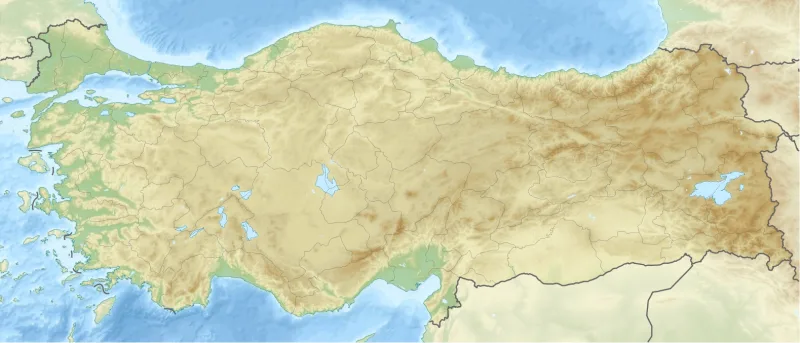
Little Olympus is located in the province of Bursa, about 35 km south of the city itself. It’s easy to get from Istanbul to Bursa in 2–3 hours: take a ferry from the Kabataş or Eminönü pier to Yalova, then a bus or dolmuş to Bursa Otogar (or a high-speed catamaran to Bursa IDO). An alternative is a direct bus from Istanbul (about 2.5 hours via the Osman Gazi Bridge).
There are two ways to get from Bursa to the mountain. The first and most popular is the Bursa Uludağ Gondola (Teleferik): the cabins depart from the city center and stop at the Kadıyayla plateau at about 1,200 meters; the final stop is Sarıalan at about 1,630 meters. This is the most scenic route. The second option is by car or taxi along the highway, which was built back in 1933; the road winds through a coniferous forest and takes about 45 minutes. From Istanbul Airport (IST), the most convenient way is by bus to Bursa Otogar and then by funicular. From Istanbul Sabiha Gökçen Airport (SAW), taking a ferry across the Sea of Marmara is even faster: to Yalova and then by bus to Bursa.
Tips for travelers
The time of year completely determines what you’ll find on Little Olympus. December–March is ski season: the slopes are packed, hotels are full, and prices are twice as high as in summer; but it is precisely in winter that the view from the chairlift window of the snow-capped peaks and the Marmara Sea in the distance leaves a lasting impression. Late April–June is the best time for nature lovers and quiet walks: the meadows are in bloom, the birds are active, and the ski crowd has already left. July–September is trekking season: you can hike up Kartaltepe in 4–5 hours from Sarıalan.
Bring warm clothes even in the height of summer: at an altitude of 2,500 meters, the temperature rarely exceeds 15–18 degrees, and the wind often picks up suddenly. Hiking boots are a must—the rocks on the ridge are sharp and slippery after rain. Cafes and restaurants are concentrated in the hotel zone around Sarıalan; there are none higher up, so bring plenty of water and food. Binoculars will greatly enhance your birdwatching experience—a bearded vulture or golden eagle in flight over the cliff is unforgettable.
For short trips from Istanbul, Little Olympus pairs well with Bursa itself: the historic center with the Ulu Mosque and Yeşil Mosque, Orhan’s Tomb, the Kapalıçarşı market, and the famous Bursa kebab—Iskender kebap—easily fit into a single packed day. And remember: Little Olympus is not just a ski resort. For those who love to peer through the layers of history, beneath every fir forest here lurks the shadow of a monk or the hunting horn of an Ottoman sultan.